
Animal Unique | Plains Zebra | Plains zebras also known as the Common Zebra or Burchell's zebra, is the most common species of zebra and the geographical distribution. The Plains zebra's range stops short of the Sahara from southern Sudan and southern Ethiopia to expand to the south along East Africa, where Zambia, Mozambique and Malawi, before spreading in most southern African countries. Plains zebras usually live in treeless grasslands and savannah woodlands, but can be found in a variety of habitats, both tropical and temperate. But they are generally absent in deserts, dense forests and permanent wetlands. Plains zebras remains common in game reserves, but is threatened by human activities such as hunting for its meat and skin, but also compete with livestock and damage to agriculture in many of its habitat.

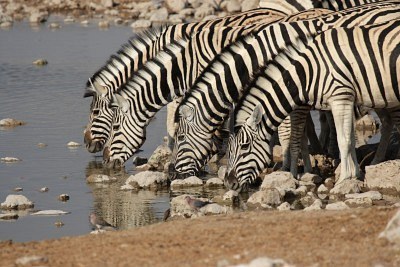
Plains zebra is medium sized, averaging less than the other two zebra species, and thick body with relatively short legs. There is some variation in size, based on the state of animals and subspecies. The males can weigh 10% more than women. Like all zebras, they are boldly striped in black and white, and no two individuals look exactly alike. They also have black or dark snouts. The birth of a foal coat is brown and white. All have vertical stripes on the bow of the body, which tend to the horizontal on the hindquarters. The northern populations have narrower and more defined striping; southern populations have varied but lesser amounts of striping on the abdomen, legs and hindquarters. Southern populations also have brown "shadow" stripes between the black and white colors. These are absent or poorly expressed in the north of zebras.

Scientific classification
Kingdom: Animalia
Phylum: Chordata
Class: Mammalia
Order: Perissodactyla
Family: Equidae
Genus: Equus
Subgenus: Hippotigris
Species: E. quagga
Kingdom: Animalia
Phylum: Chordata
Class: Mammalia
Order: Perissodactyla
Family: Equidae
Genus: Equus
Subgenus: Hippotigris
Species: E. quagga
The striping pattern of the zebra is unique among sympatric ungulates. A proposed function for the stress to the animal to camouflage in tall grass or in the dappled shade under the bushes and trees. But animals that use camouflage, such as kudu and bushbuck, tend to be quiet and stealthy. They freeze when danger and flee at the last moment. By contrast, the zebra is active and noisy, and makes no attempt to hide itself. Perhaps the best explanation for the stripes is that they serve a social function. Individual zebras apparently can recognize each other by their stripes patterns. The stripes can also serve as visual cues for care. They can also serve to help zebra groups stay together if they are fleeing.

Unlike many of the large ungulates of Africa, Plains zebra is not necessary (but still prefers) short grass to graze. It eats a wide range of different grasses, rather young, fresh growth where available, and also browse on the leaves and shoots from time to time. The overall purpose of the wider than many other species, even in forests, and it is often the first grazing species to appear in a well vegetated area.zebras less selective in foraging, but they spend much time eating. Plains zebra is a pioneer grazers and paves the way for more specialized grazers like blue wildebeest and Thomson's gazelles that rely on shorter and more nutritional grasses. Large predators of Plains zebra is such as lions and spotted hyenas. Nile crocodiles are also great threats during river crossings towing. Wild dogs, cheetahs, leopards and hunting zebras, although the dangers they pose are generally low and they usually attack the foals.

Plains zebra a is highly social and usually forms small family groups called harems, consisting of a single stallion, several mares, and their recent offspring. The adult membership of a harem is highly stable, usually stay together for months to years. Groups of all male "bachelor" also exist. These are stable groups of 2-15 men with an age-based hierarchy led by a young man. These men remain in their group until they are ready to start a harem. The bachelors prepare for their adult roles in the game fighting and greeting / challenge rituals, which provide the bulk of their activities. Stallions form harems by abduct young mares of their family harems.

Mares exist in a hierarchy, with the alpha as the first female to mate with the stallion and one to lead the group. When new mares are added to the group, they are met with hostility by the other mares. Thus, the stallion to shield the new mares until the aggression disappears. A stallion will defend his group of other males. When challenged, the stallion should be a warning to be issued to the invader by rubbing nose or shoulder with him. If the warning is not followed, a fight breaks out. Zebra fights often very violent, with the animals biting at each other's neck, head or legs, wrestling on the ground, and occasionally kicking. At least six different conversations are documented for the plains zebra. When a predator is detected, a zebra a two-syllable alarm. A loud snort is made by moving the cover of potential danger. When you are satisfied, a zebra a more drawn-out snort. The males make a short high-pitched squeak when hurt and foals will be a long wail to emit emergency.

Mares exist in a hierarchy, with the alpha as the first female to mate with the stallion and one to lead the group. When new mares are added to the group, they are met with hostility by the other mares. Thus, the stallion to shield the new mares until the aggression disappears. A stallion will defend his group of other males. When challenged, the stallion should be a warning to be issued to the invader by rubbing nose or shoulder with him. If the warning is not followed, a fight breaks out. Zebra fights often very violent, with the animals biting at each other's neck, head or legs, wrestling on the ground, and occasionally kicking. At least six different conversations are documented for the plains zebra. When a predator is detected, a zebra a two-syllable alarm. A loud snort is made by moving the cover of potential danger. When you are satisfied, a zebra a more drawn-out snort. The males make a short high-pitched squeak when hurt and foals will be a long wail to emit emergency.

The stallion mates with all his mares. Mares may give birth to a foal every twelve months. The birth peak in the rainy season. She nurses the foal for up to one year. The stallion is generally intolerant of foals that were not his. Like horses, zebras can stand, walk and suckle shortly after they are born. At the time of birth, a mother zebra keeps any other zebras away from her foal, including the stallion, the other females, and even the previous offspring. Later, however, they bond. Within the group, a foal has the same rank as his mother. Young male zebra eventually leave their families. This is not because of sexual maturity or kicked by their fathers, but because their relationship with their mothers have faded after the birth of a sibling.

To protect land predators Plains zebra retreats into open areas with good visibility at night. When the foraging groups or sleep, zebra will watch, and if a predator is spotted, the barking or snort loudly. The harem stallion will go into the attack and the attack dogs or hyenas. In contrast to the stallions, mares typically only react aggressively to dogs or hyenas when their foals are threatened. Unlike wildebeest, zebras rarely take to the water to escape the hyenas. With lions, a zebra best defense is to surpass them, as lions do not have as much stamina as hyenas or wild dogs. Cheetahs and leopards are usually threats of foals and adult zebra is fully capable of driving them away.
To protect land predators Plains zebra retreats into open areas with good visibility at night. When the foraging groups or sleep, zebra will watch, and if a predator is spotted, the barking or snort loudly. The harem stallion will go into the attack and the attack dogs or hyenas. In contrast to the stallions, mares typically only react aggressively to dogs or hyenas when their foals are threatened. Unlike wildebeest, zebras rarely take to the water to escape the hyenas. With lions, a zebra best defense is to surpass them, as lions do not have as much stamina as hyenas or wild dogs. Cheetahs and leopards are usually threats of foals and adult zebra is fully capable of driving them away.
Animal Unique


