Tampilkan postingan dengan label Tiger. Tampilkan semua postingan

Rabu, 24 Juni 2015

Siberian Tiger


Animal Unique | Siberian Tiger | Siberian tigers or Amun tigers are large carnivores in coldest areas of the earth. They are the world's largest cat and one of the most endangered species. Approximately 80% of Siberian tigers live in the coniferous, scrub oak and birch forests of the Primorsky Krai region of Russia (eastern Russia). Today, their number in China and Korea are much reduced because of illegal poaching. It is estimated that approximately 350 to 400 tigers in the wild and 490 are in zoos. Important habitat for the Siberian tigers are Korean pine broadleaf forest with a complex composition and structure. This tigers prefer to live a lonely life and large areas, some of these areas is greater than 4000 square miles. 


Scientific classification
Kingdom:     Animalia
Phylum:     Chordata
Class:     Mammalia
Order:     Carnivora
Family:     Felidae
Subfamily:     Pantherinae
Genus:     Panthera
Species:     P. tigris
Subspecies:     P. tigris altaica

Siberian tigers are huge and the possession and impressive body frame. Their orange color is actually paler than other tigers and it is widely spaced brown stripes instead of black. It has a white chest and belly and a thick ruff of hair around her neck. The skull of the Siberian tiger is distinguished by its larger overall size, but also the development of the ridge, the height and strength greater than that of other tigers and lion. A female skull is always smaller and has never been so heavily built and robust as that of a man. 


The ground color of the Siberian tigers' fur is often very pale, especially in winter coat. However, variations in substantially populations. Variation is also in the shape, length, and partly in the color of the dark lines, which have been described as a dark brown or black. Generally, the coat of the western population was brighter and more uniform than that of the Far East populations. The summer coat is coarse, while the winter is closer, longer, softer and softer. The winter fur is often quite rough on the trunk, and is clearly more on the head, almost to the ears. The whiskers and hair on the back of the head and upper neck are also greatly extended. The color of the winter coat is generally less bright and rust in relation to the summer coat. As a result of the winter coat of the greater length, the stripes wider with less defined outlines. 


Siberian tigers have 20 pounds of meat for their daily diet. They mostly eat deer, elk and wild boar. Monkeys, birds, frogs and fish form their diet in times of food scarcity. Tigers may prey on both brown and black bears at ungulate populations decrease. They most typically attacking brown bears in the vicinity of the hibernaculum in the winter. Brown bears are attacked by tigers more often than black bears, as a result of their habit of living in more open areas and their inability to climb trees. When hunting bears, tigers will position themselves in the lee of a rock or a fallen tree, waiting for the bear to pass. When the bear goes, the tiger shoot from an overhead position and grab the bear under the chin with a paw and throat with the other. 


Siberian tigers can be very fast speeds of up to 50 mph running, however, they can only maintain this speed over short distances. In fact, only one out of ten of their hunting also actually to be successful. They hunt mainly at night; their excellent night vision and highly developed senses of hearing and smell allow. The night vision goggles six times better than that of humans. Siberian tigers living in the wild to survive as long as 15 years, but those in captivity have a smaller life. In fact, Siberian tigers survive frost and in case of a fight, they warn the invaders advance by rattling their tails. 


Siberian tigers breeding season tends to be from December to January. The normal gestation period is three to three and a half months. Siberian tigers are sexually mature at four years. They mate at any time of the year. A female signals her receptivity by leaving urine deposits and scratches on trees. An average litter size is three or four cubs. The cubs are born blind and are about as big as a house cat. After about two weeks eyes open and their teeth begin to grow. They are weaned at six months and independently by 18 months. They will hunt on their own to start in their first year, but they do not let their mother and their own territory to the achievement of three to five years old. Unfortunately it is common that only one young per litter to survive to maturity. 


The shrinkage of Siberian tiger habitat is one of the most important reason, except that their number is reduced poaching. In most cases, the timber has been carried out illegal. Although it is illegal to kill a tiger, tigers are still poached today because their body parts can be sold on the black market for large sums of money. The tiger parts are sold for their fur and use in traditional Chinese medicine. Forrest fragmentation and poaching have both taken their toll on the tiger numbers, but in Korea logging of Korean Pines seems to constitute the greatest threat. Korean pines produce a good quality wood that is mainly used for pencil production. The Pine is crucial for the survival of the tiger population, because the nuts are an important food source for elk, deer and wild boar - the main prey of the tiger. The survival of the Siberian tiger is largely dependent on the protection of Korean Pine.

Animal Discovery And Animal Unique In The World
Animal Unique

Selasa, 23 Juni 2015

Sumatran Tiger


Animal Unique | Sumatran Tiger | Sumatran tiger is a rare subspecies of tiger that inhabits the Indonesian island of Sumatra. It was classified as critically endangered by IUCN in 2008. The Sumatran tiger is only available on the Indonesian island of Sumatra in habitat that ranges from lowland forest to sub mountain and mountain forest including some peat moss forests. Sumatra has undergone significant growth in agriculture, and as a result, Sumatran tiger habitat has been fragmented with about 400 tigers inhabiting five national parks and two game reserves. The largest populations live in the Kerinci Seblat National Park and Gunung Leuser National Park. Another 100 live in unprotected areas in danger of being lost to agriculture from 2015. The tigers live in unprotected areas are very susceptible to poaching and killing of problem animals that come into contact with residents compromising the animals' habitat. 


Scientific classification
Kingdom:     Animalia
Phylum:     Chordata
Class:     Mammalia
Order:     Carnivora
Family:     Felidae
Genus:     Panthera
Species:     P. tigris
Subspecies:     P. t. sumatrae

Sumatran tiger is described as darker coat color and as with thicker lines than the Javan tiger. Stripes tend to fall apart near places their ends, and the lines of small dark spots between regular stripes can be found on the back, flanks and hind legs. The frequency of lines is higher than in other subspecies. Sumatran tiger is one of the smallest subspecies of tiger. The males have a beard and mane appearance, neck and cheek hair are well developed. The smaller size of the Sumatran tiger makes it easier to scan through the jungle. 


Patterned colors of Sumatran tiger is an adaptation for camouflage in their natural environment, often tall grass. Webbing between their toes, when spread, the Sumatran tiger and very fast swimmer. They will, if given the chance, run hoofed prey into the water much slower swimmers. The white spots on the back of the tiger's ears are "eye spots" or "predator spots". These places are supposed to function and false eyes look bigger to make a predator from behind. This is especially useful in accordance boy safe. Sumatran tigers often hunt larger ungulates such as wild pig, Malayan tapir, and deer, and sometimes also smaller animals such as birds, monkeys and fish. Orangutans could be prey, but because they spend minimal time on the ground, tigers rarely catch. 


The extent of the reach of a tiger depends on the availability of habitat and prey. His vision and hearing are very acute, good for the tiger that such an efficient predator. Sumatran tiger lives alone for the most part, and there is only occasional cooperation between different individuals. A male will not allow other males remain in his territory, but will allow other males passing through his area. The hunting method is slow and patient, stalking through the often dense cover until close enough to the spring. Sumatran tigers in general tend to fall prey to the side or rear of the nearby and as prey for more than half of the tiger weighs a throat bite is used and the death caused by suffocation. Sumatran tiger can often be found in a pool or stream, or standing in water to cool. Male and female tigers mark their range by spraying scent on trees or bushes. 


Tigers can breed at any time of the year, but they usually mate in winter or spring. Tigers seem to reach maturity at about 4 years, but earlier maturity recorded. Is usually 103 days gestation. The usual number of cubs is two or three, but there may be no less than six. The cubs are blind and helpless at birth, weighing about 3 pounds each. Their eyes usually open by the tenth day, though some zoo born cubs have their eyes open when they are born. During the first 8 weeks, the cubs consume only their mother's milk. Female nursed 5 or 6 months. The young leave the den for the first time when they are 2 months old. They are completely dependent until about 6 months old when they learn how to kill. They may find themselves by the time they are about 18 months old and are fully independent at two years. Sustainability in the wild is 15 years and 20 years in captivity. 


Habitat for the Sumatran tiger is drastically reduced by logging, clearing for agriculture and plantations, and Settlement. Indonesian forestry officials acknowledge that in many parts of the island, illegal logging and forest conversion are out of control. Habitat destruction not only reduces the tiger numbers, but also prey. As a result, tigers move into settled areas in search of food, where they are more likely to come into conflict with people. Indeed, human-tiger conflict is a serious problem in Sumatra compared with other parts of the global reach of the tiger. People are slain or wounded, and livestock fall prey to tigers. Retaliatory Action by the villagers can lead to killing the tiger. Although the number of tigers slain incidentally or as a result of human-tiger conflict are significant, most tigers in Sumatra apparently deliberately slain for commercial gain.

Animal Discovery And Animal Unique In The World
Animal Unique

Minggu, 21 Juni 2015

Tiger


Animal Unique | Tiger | Tiger is the largest cat in the world and the world's largest tiger sub-species is the Siberian tiger. It is estimated weight of the male is 500 pounds and the female is 300 pounds. The average length of the male tiger is 10 meters and the female 8 feet. The average height of a tiger is 3 feet. The appearance of the tiger depends largely on where the animal lives. Tigers once ranged widely across Asia, from Turkey in the west to the east coast of Russia.Today, they range from the Siberian taiga and grasslands to tropical mangrove swamps to open. 


Scientific classification
Kingdom:     Animalia
Phylum:     Chordata
Class:     Mammalia
Order:     Carnivora
Family:     Felidae
Genus:     Panthera
Species:     P. tigris

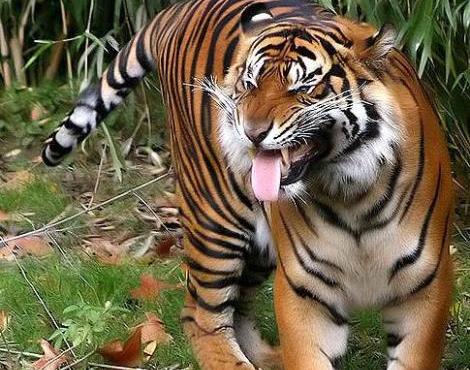
Tigers have muscular bodies with a very powerful front legs and big heads. The coat color varies from shades of orange or brown with white belly areas and distinctive black stripes. The face has long whiskers, which are especially long in males. The pupils are round and yellow irises. The pattern of stripes is unique to each animal, these unique markers are used by researchers to identify individuals, much the same way that fingerprints are used to identify people. It seems likely that the function of stripes is camouflage, serve to help tigers to hide under the dappled shadows and long grass of their environment as they stalk their prey. 


Tigers that live in cold regions are paler in color and larger in size, their coat is long and thick. The tiger is the most variable in size of all big cats, even more than the leopard and much more so than lions. In warmer climates, tigers are smaller and more colorful, they have shorter, thinner fur. The fur on the back of the tiger is very thick and pale stripes. The color of the Siberian tiger is yellow-brown, while the Indian tiger is brown. The stripes on a tiger are very dark. Like all cats, tigers have sharp claws and teeth. 


Tigers usually stalk their prey alone and at night. To kill, the tiger leaps on the animal, biting his neck. It takes the slain animal is a hidden place. If a large animal, the tiger feeds on it for many days. During this time, the tiger is not dead. Tigers hunt deer, elk, rabbits, birds, fish, bears, moose, lynx, hares, pigs, cattle, goats, and several smaller animals. The main food of tigers are buffalos, antelopes and rodents. Tigers can work quickly and silently. Jump with ease, tigers can cover 15 feet (4.5 meters) in a jump, they can jump great distances over obstacles and land. The tiger rarely climbs trees, but swims well. 


Young tigers or cubs are born 100 to 112 days after the parents have covered. Usually tiger cubs are born between February and May after a gestation of three and a half months. The cub weighs less than three pounds at birth and are striped. The cubs' eyes open in 15 to 16 days. a nest consists of 1 to 4 young, sometimes up to 6, but only 2 to 3 survive. The mother is responsible for defending her cubs, while the father hunts for food. Tiger cubs are weaned after 4 to 6 months, but dependent on their mother for food and protection for another 2 years the new males entering a female tiger territories can kill her her cubs. Cubs learn how to kill at 16 months, and they are on their own in 2 to 3 years. The white ear spots help the mother tigers and cubs to keep track of each other in dark woods at night. Life spans of tigers is 15 to 16 years. In zoos, tigers can live from 20 years old, but they rarely meet this old to be in the wild. 


Tigers may kill such formidable predators as leopards, pythons and even crocodiles occasionally, but most predators avoid each other. The tiger has few enemies, except humans, they are large buffaloes, elephants and bears. The defense against other animals that may attack the large claws and powerful teeth. Tigers are excellent swimmers and climbers, who will save them from floods and other disasters, but also protect them against their enemies. The tiger is a very cautious animal, does not like to hunt elephants or larger animals than itself, unless very hungry, or if the boy or itself were attacked. 


The main enemy of the tiger is humankind. They are trapped, poisoned and hunted heavily by humans not only to eliminate cattle, but also for sport, trophies, skins, and sources of traditional medical products. Superstition has surrounded tigers for centuries; their body parts are used in Asian medicines. Neck of the Latvian tiger claws are thought to protect a child against the "evil eye", tiger whiskers are considered either a dreadful poison, a powerful aphrodisiac, or an aid to childbirth, bones, fat, liver and penis of a tiger are valued as medicines. 


Tiger is one of the Big Five game of Asia. Tiger hunting took place on a large scale in the beginning of the nineteenth and twentieth centuries, who have recognized and admired sport by the British in colonial India and the maharajas and aristocratic class of the former princely states of pre-independence India. The Bengal tiger is the national animal of India and Bangladesh. The Malayan tiger is the national animal of Malaysia. The Siberian tiger is the national animal of South Korea. The tiger replaces the lion as king of the beasts in cultures of East Asia royalty, fearlessness and wrath.

Animal Discovery And Animal Unique In The World
Animal Unique

Bengal Tiger


Animal Unique | Bengal Tiger | Bengal tiger is a subspecies of the tiger from the Bengal region of South Asia. Bengal tiger roams a wide range of habitats including high altitude, tropical and subtropical rainforests, mangroves and grasslands. They occur mainly in parts of India, Nepal, Bhutan, Bangladesh and Myanmar. In 2010, classified as endangered by IUCN. The total population is estimated at less than 2,500 people with a decreasing trend, and none of the Tiger Conservation Landscapes within the range of the Bengal tiger is large enough to be an effective population size of 250 adult individuals to support. 


Scientific classification
Kingdom:     Animalia
Phylum:     Chordata
Class:     Mammalia
Order:     Carnivora
Family:     Felidae
Subfamily:     Pantherinae
Genus:     Panthera
Species:     Panthera tigris
Subspecies:     Panthera tigris tigris

Bengal tiger is a beautiful animal. The base color is orange / brown, and white on the cheeks, mouth, eyebrows and stomach. The tiger also has long black stripes on it. All white tigers are a variation in color of the Bengal tiger has been reported that some tigers are white, with or without black stripes. The weight of the tiger can be up to 575 pounds. Bengal tiger is the largest tiger in the world, his cousin, the Siberian tiger is the largest tiger. The body of the Bengal tiger is wide with legs are slender. The coat of the tiger is very fine structure. The Bengal tiger is very sneaky and quiet. The cubs look the same. Bengal tiger can be up to three meters long and three meters high. 


Bengal tigers hunt medium and large animals such as wild boars, are water buffalo, goats and deer are know to prey on small elephant and rhino calves. Bengal tiger can capture large animals, but prefers the killing of a young or old animals, because they do not run as fast. He Bengal tiger is a nocturnal predator and greatly feared. Bengal tigers kill their prey by severing the spinal cord, or the infliction of a suffocation bite (usually for larger prey). Bengal tigers are known to other predators such as leopards, wolves, jackals, foxes, crocodiles, Asiatic black bears, sloth bears and dholes as prey to be taken, although these predators are not typically part of their diet. Adult elephants and rhinos are too large to be successfully addressed by tigers, but such extremely rare events are included. 


The basic social unit of the Bengal tiger is one of the elemental mother and offspring. Adult animals gather only on an ad hoc and temporary basis in special circumstances allow, as large supply of food. Otherwise they lead solitary lives, hunting for individual disseminated high forest and grassland animals, which they prey. They establish and maintain habitats. Resident adults of both sexes usually have their movements restricted to a particular habitat area in which they meet their needs and tigresses that growth of their young. Besides providing the requirements of an adequate food, adequate water and shelter, and a degree of peace and seclusion, this place make it possible for the resident to keep in touch with other tigers, especially those of the opposite sex . Those same soil are well aware of each other's movements and activities. 


Bengal tiger males reach maturity in 4-5 years, and females at 3-4 years. After a gestation period of 104-106 days, 1-4 young are born in a shelter located in tall grass, thick bushes or in caves. They have a thick woolly coat. Their eyes and ears are closed. The milk teeth begin to erupt at about 2-3 weeks after birth, and are slowly replaced by permanent teeth. At the age of 2-3 years, they slowly begin to separate from the family and transient to be - in search of an area, where they establish their own territory. Young men move further away from their mother's territory than young women. Once the family group is divided, the mother comes into heat again. 


In the past century, tiger numbers have drastically declined, with a declining population trend. None of the Tiger Conservation Landscapes within the Bengal tiger range is large enough for an effective population size of 250 individuals to support. As with other types of tigers, habitat loss and poaching are the main threats to the survival of the Bengal tiger. They are not only slain for their skin and their body parts used to make traditional Asian medicines. The reason why poachers and other people hunt beautiful animals like tigers because the eyes, bones, and even whiskers are very valuable for researchers who are creating drugs to treat or cure human ailment, and to give people a longer life.

Animal Discovery And Animal Unique In The World
Animal Unique