Tampilkan postingan dengan label Lizard. Tampilkan semua postingan

Minggu, 14 Juni 2015

Savannah Monitor


Animal Unique | Savannah Monitor | Savannah monitor is a monitor lizard species from Africa. The species is known as the Bosc's Monitor in Europe since the French scientist Louis Bosc first described the species. Comes from Africa, Savannah monitors have a dry, warm environment for them to thrive in. They spend most of their time in the wild basking in the sun. The range stretches across sub-Saharan Africa from Senegal to Eritrea and northern Zaire. Savannah monitor is primarily a ground dwelling species that shelters in burrows, although sometimes in bushes or low trees. In the coastal plain of Ghana, Savannah monitor youth often associated with the burrows of the great cricket Brachytrupes. 


Scientific classification
Kingdom:     Animalia
Phylum:     Chordata
Class:     Reptilia
Order:     Squamata
Suborder:     Lacertilia
Family:     Varanidae
Genus:     Varanus
Subgenus:     Polydaedalus
Species:     V. exanthematicus

Savannah monitor is built very brave. Strong limbs with claws as sharp claws for digging holes and climbing, very powerful jaws that could easily crush the exoskeletons of invertebrate prey, and powerful, so short tail. The maximum size is seldom more than 3.5 meters in length. The vast majority are usually 3 to 4 meters. The pattern on the back of uniformly gray to pale cream, dove, white or light blue spots. The monitor has a short, box-like head and large dorsal and nuchal scales. The short tail is round, and stores fat as an energy reserve. 


Unlike most monitors are carnivorous, the Savannah monitor is a highly specialized insectivore. Although it will consume mammals, they would wander over the road, they will not actively looking for mammals as prey, and it is generally not recommended that they be fed a diet of mammals in captivity. Mammals are rich in fat and can cause health problems, most related to obesity and malnutrition. A generalist in the wild, Savannah monitors eat cockroaches, scorpions, spiders, worms, centipedes, grasshoppers, and a variety of other invertebrates. The feeding behavior of this and most species the monitor is very aggressive rampage. 


The Savannah monitor prefers to flee or risk death to play, but if cornered, defends itself with its tail lashes and if necessary, a powerful, vise-like grip. The thick skin is resistant to most bites and it claims that the lizard is immune to most snake venom. When confronted with a large predator, the monitor rolls on his back and grabs a hind leg in his mouth, forming a ring with his body and making itself more difficult for the animal to swallow whole while playing dead. Savannah monitors, such as most monitors will extend their throat and body to present a larger profile also. They will also marvel and let out a slow, deep hissing sound when threatened. 


Savannah monitors are larger pet lizards that are known are some of the more docile lizards of the Monitor Group. They are not really active lizards, but generally tolerated the treatment very well. Savannah monitors will grow to about 3 to 4 feet long. Regular use will tame them but like all monitors, as they are not a captive bred baby or are not handled often savannah monitors can become aggressive. As with any exotic animal, the more natural diet, the better. Savannah monitors eat gut loaded insects like crickets, cockroaches, and earthworms together with appropriately sized rodents. Savannah monitors can be voracious eaters. So if they bite-sized bed that they can get a mouth full when trying to grab their food. If the savannah will enjoy his food in his basket, choose a bed that will not lead to impaction.

Animal Discovery And Animal Unique In The World
Animal Unique

Selasa, 09 Juni 2015

Komodo Dragon


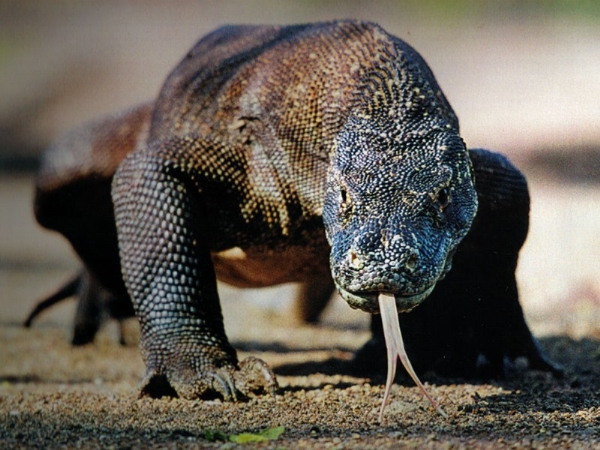
Animal Unique | Komodo dragon | Komodo dragon is also known as the Komodo monitor. Komodo dragons are the world's heaviest living lizards. The distribution of the Komodo dragons is restricted to the Lesser Sunda Islands of Rinca, Komodo, Flores and the smaller islands of Gili, Montang and Padar. Padar does not have a permanent population. The total range is less than 1,000 square kilometers. Komodo National Park, all islands except Flores. However, recent research suggests that the large size of the Komodo dragons can be better understood as representing a relict population of very large varanid lizards that once lived in Indonesia and Australia, most of which, along with other megafauna, who died after the Pleistocene.


Scientific classification
Kingdom:     Animalia
Phylum:     Chordata
Subphylum:     Vertebrata
Class:     Reptilia
Order:     Squamata
Suborder:     Lacertilia
Family:     Varanidae
Genus:     Varanus
Subgenus:     V. (Varanus)
Species:     V. komodoensis

  
The natural habitat of Komodo dragons is extremely fast by human standards. These arid volcanic islands have steep slopes and little available water most of the year. A short rainy season often produces local flooding. Dragons are the most numerous in the lower dry forest and savanna. In the wild, an adult Komodo dragon usually weighs around 70 kilograms, although captive specimens often weigh more. The Komodo dragon has a tail as long as his body, but also about 60 frequently replaced serrated teeth that can measure up to 2.5 inches long. The saliva is frequently blood-tinged, because the teeth are almost completely covered by gingival tissue that is naturally ruptured during feeding. This provides an ideal culture for the bacteria that live in his mouth. It also has a long, yellow, deeply forked tongue.


Keen sense of smell the Komodo dragon, the granting of aid by the favorable wind, makes it possible to search for carrion. to 5 miles away. Despite its size, the Komodo dragon is fast moving and agile. They can climb trees and like all monitor lizards are good swimmers. Their teeth are laterally compressed with serrated edges, similar to those of meat-eating sharks. They have about 60 teeth that replace them often and are positioned to cut out pieces of his prey. The highly flexible skull makes it possible to swallow large pieces of its food. The Komodo dragons mouth is full of virulent bacteria and even if its prey survives the original attack, it will later die of infection. In addition, recent research suggests that the Komodo dragons a poison gland that is more important in turning off their prey have. 


Komodo dragons are carnivores. Although they eat mostly carrion, they will also ambush live prey with a stealthy approach. When suitable prey arrives near a dragon's ambush site, it suddenly in charge of the animal and go for the underside or the throat. It is able to its prey to localize by means of the sense of smell, which is a dead or dying animal can be found from a range of up to 9.5 kilometers. Komodo dragons have been seen tearing down large pigs and deer with their strong tail. Komodo dragons eat by tearing large chunks of meat and swallow them whole while the carcass down with their front legs. For smaller prey up to the size of a goat, their loose articulated jaws, flexible skull, and allows the stomach to expand its prey to swallow them whole. 


In the wild, Komodo dragons are generally solitary animals except during breeding season. Men maintain and defend a territory and patrol up to 1.2 miles per day. Areas depend on the size of the dragon. The feeding range to expand and can be shared with other men. A Komodo dragonn will allow other dragons on its territory to stabbing when they are on a food run. Komodo dragons maintain burrows within their core ranges and occasionally males swim from island to island over long distances. They regulate their body temperature with the aid of a hollow. 


Komodo dragons are formidable predators, because even one bite can kill. The bacteria that live in the dragon's saliva are so virulent that wounds often will not heal. Even if the victim remains, usually die of infection within a few days. The dragon's reputation as a man eater is well deserved, it does not seem to fear humans and many attacks and deaths were reported. The current population of Komodo dragons seems relatively stable at about 5,000 animals, but scientists are concerned that only 350 of them are women breeding. This can be a normal sex ratio, little is known about the species. Limited spread of the dragon makes them highly susceptible to natural or manmade events such as storms, fire or disease. 


The main threats to the survival of the Komodo dragon include illegal hunting and loss of habitat to human settlement. As was the case with most large, spectacular animals around the world, Komodo dragons are sought as trophies by big-game hunters. They are slain for skins and feet to make novelties. In the beginning of this century, many Komodo dragons captured for sale to zoos and private collectors. Komodo dragons are the center of a thriving tourism industry and local people are increasingly recognizing the benefits of living near these potentially dangerous animals. Because of the remote island of Komodo, the visitors to the island to stay in local hotels and hire local guides. In some areas, the Komodo dragons are so well fed that they are just waiting for the next group of tourists to the next meal of goat or sheep to carry.

Animal Discovery And Animal Unique In The World
Animal Unique

Senin, 08 Juni 2015

Plumed Basilisk


Animal Unique | Plumed Basilisk | Plumed Basilisk, Animal skills is a Central American lizard with an unusual habit. The plumed basilisk spends much of its time in streamside trees or shrubs waiting for an insect or small vertebrate to pass close enough so it can pounce and devour it. But when the lizard is threatened, it drops down into the stream and escapes by walking across the water on its hind feet, using its tail for added support. Aptly nicknames the “Jesus Christ lizard,” this beautiful turquoise-green reptile is also known for its running speed on land – up to 7 miles per hour – and for its ability to remain submerged underwater for up to 30 minutes.
Scientific classification
Kingdom:     Animalia
Phylum:     Chordata
Class:         Sauropsida
Order:         Squamata
Family:         Corytophanidae
Genus:         Basiliscus
Species:     B. plumifrons


The plumed basilisk, Basiliscus plumifrons, also called a green basilisk or double crested basilisk and Jesus Christ Lizard, is a species of lizard native to Latin America. Its natural range covers a swath from Mexico to Ecuador. The green basilisk's generic name basiliscus is taken from the legendary reptilian creature of European mythology which could turn a man to stone by its gaze: the Basilisk. This name derives from the Greek basilískos  meaning "little king". This epithet was given in Carolus Linnaeus' 10th edition of Systema Naturae.
Green basilisks are bright green with small bluish spots along the dorsal ridge. These lizards may grow up to 3 ft (1 m) in length (most of which is tail), with an average length of about 2 ft (0.6 m). Males have three crests: one on the head, one on their back, and one on the tail. The females, however, only have one crest, on the head. Green basilisks are omnivorous and eat insects, small mammals (such as rodents), smaller species of lizards, fruits and flowers. Their predators include birds of prey, opossums and snakes. The females of this species lay five to fifteen eggs at a time in warm, damp sand or soil. The eggs hatch after eight to ten weeks, at which point the young emerge as fully independent lizards.
Males are very territorial; a single male may keep land containing a large group of females with whom he mates. Most basilisks are skittish and do not tolerate much handling. This lizard is able to run short distances across water using both its feet and tail for support, an ability shared with other basilisks and the Malaysian sail-finned lizard, Hydrosaurus amboinensis. In Costa Rica, this has earned the plumed basilisk the nickname "Jesus Christ lizard". It is also an excellent swimmer and can stay under water for up to 30 minutes.

Animal Discovery And Animal Unique In The World