Tampilkan postingan dengan label Fish. Tampilkan semua postingan

Minggu, 19 Juli 2015

Tiger Shark


Animal Unique | Tiger Shark | The tiger shark gets it's name from the black stripes it has when it is young. Most tiger sharks lose these stripes as they get older. The tiger shark is the fourth biggest shark in the world. The shark tiger is found in warmer and tropical waters in the Southern Hemisphere and  tends to be found in more coastal waters but tigers sharks are also known to go into the deeper ocean if they need to hunt for food. The tiger shark is a fierce predator and tiger sharks hunt everything in the water including fish, seals, birds, turtles and even other sharks.


The tiger shark also has a wedge-shaped head which allows the shark to turn quickly when it needs to. Tiger sharks can reach a top speed of around 20mph which is pretty fast in the water! Like most other species of shark, tiger sharks have sensors on the sides of their heads which enable them to detect small muscle movements from nearby creatures.  Tiger sharks are extremely aggressive animals are thought to be one of the most dangerous sharks for humans to come into contact with. 


Tiger sharks are solitary hunters and usually do most of their hunting at night when the tiger shark can move through the water unseen. Female tiger sharks mate every three years or so and the time of year when this happens depends on where the tiger shark lives. 


Tiger sharks in the Northern Hemisphere mate from March to May, where tiger sharks in the Southern Hemisphere mate from November to January. The eggs hatch inside the female tiger shark and can remain inside her for up to 16 months. When they are big enough, the female tiger shark gives birth to between 10 and 80 baby tiger sharks.


Tiger sharks usually range from between 3 to 5 metres in length. Although much larger specimens have been seen, the largest a tiger shark tends to get is around 5.5 metres long. 
Animal Discovery And Animal Unique In The World

Whale Shark


Animal Unique | Whale Shark | The whale shark is thought to have developed around 60 million years ago making the whale shark one of the oldest species on Earth today. The whale shark is the largest species of fish with some adult whale sharks growing to nearly 50ft long. Unlike many other species of shark, the whale shark is known to feed on large shoals of tiny fish rather than hunting bigger fish and sea mammals. This makes the whale shark a filter feeder similar to whales and smaller sea animals.


The whale shark is the perfect example of a so-called friendly shark and to date have posed no significant threat to humans (mainly divers). The whale shark inhabits the warm, tropical waters around the equator and despite often being found close to coastlines, the whale shark is also known to dive to depths of up to 700 meters (that over 2,000ft deep). In this part of the ocean, food is more scarce and the whale shark will therefore only venture to such depths if hunting in the shallower waters is not possible. 


The whale shark is most commonly spotted around the Gulf of Mexico and the Indonesian Islands where the whale sharks have been known to be almost playful towards humans. Whale sharks tend to live for around 60 to 80 years but have been known be more than 100 years old. 


Female whale sharks incubate their eggs inside them rather than outside. This means that whale sharks effectively give birth to live young. Inside the female whale shark are hundreds of eggs but only a few actually turn into baby whale sharks. The remaining eggs are thought to be there so that when the whale shark pups hatch, they have something to eat. The female whale shark gives birth to an average litter of 12 whale shark pups that are around 60 cm long.


Whale sharks grow quickly during their first few years and soon the whale shark pups are extremely big and therefore less likely to be hunted by marine predators such as other shark species and killer whales. 
Animal Discovery And Animal Unique In The World

Grey Reef Shark


Animal Unique | Grey Reef Shark | The Grey reef sharks are one of the smaller species of shark with adults reaching a maximum length of around 2m long. The grey reef shark is one of the most common species of shark found in the warm waters of the Indian and Pacific Oceans. Grey reef sharks are generally found in the coastal regions and along continental shelves from the Middle East to the islands in the deep Pacific.


The grey reef shark tends to move about slowly gliding silently through the water at speeds that often do not exceed a few miles an hour and the grey reef sharks are commonly known to lay on the ocean floor for long periods of time. However, when the grey reef shark detects food in the water, the grey reef shark is known to suddenly become very active and quick, with the grey reef shark often becoming fairly aggressive if there is food about.


Grey reef sharks feed on reef fish, squid and shrimp. The grey reef shark is not thought to pose a great threat to humans and the grey reef shark has been noted to be inquisitive towards divers. Other species of reef shark include the white tipped reef shark, the black tipped reef shark and the Caribbean reef shark, all of which belong to the same family so have similar characteristics to the grey reef shark.


The grey reef shark has a very distinctive shark-like appearance which includes the long slender body of the grey reef shark, large fins and a rounded snout. The grey reef shark tends to gather together in schools with other grey reef sharks during the day, but the grey reef shark is generally more active at night. The grey reef shark has very few natural predators in its coastal, underwater habitat as many larger water-bound carnivores tend to lurk in the deeper waters. 


When the grey reef shark feels under threat, particularly from larger species of shark or from humans diving, the grey reef shark tends to react in a very distinctive way with the grey reef shark arching its body up and moving its head slowly from side to side whilst the grey reef shark is swimming along. The grey reef shark is thought to do this to intimidate unwanted company rather than in preparation to attack it.
Animal Discovery And Animal Unique In The World

Hammerhead Shark

Animal Unique | Hammerhead Shark | Hammerhead sharks are large carnivorous fish that prey on large fish and occasionally hammerhead sharks will hunt small water mammals.  Hammerhead sharks are found in the warmer waters of oceans worldwide but hammerhead sharks are particularly found in coastal waters, and along continental shelves. Hammerhead Sharks are appropriately named after their flat shaped heads.
Hammerhead sharks are not commonly known to attack humans but can be aggressive if a human came into contact with a hammerhead shark. The flat shaped head of the hammerhead shark is thought to allow the hammerhead shark to detect prey more easily, as it increases the hammerhead sharks sensitivity to sonar activity. Hammerhead sharks are thought to use sonar waves detection in a similar way to their five main senses, so its like the hammerhead shark has a sixth sense.
 
The shape of the head of the hammerhead shark is made up of two projections on either side of the face of the hammerhead shark, which gives the hammerhead shark the head shape that resembles a hammer almost rectangular in shape. The eyes and nostrils of the hammerhead shark are found at the ends of the hammer allowing the hammerhead shark to have better vision and smell of the surrounding water. 
 
 Like many other species of shark the hammerhead shark is a solitary hunter during the night, but during the daytime hammerhead sharks are known to form schools of up to 100 hammerhead shark individuals. Hammerhead sharks are commonly seen in larger groups during the summer months when the hammerhead sharks are migrating together in search of cooler waters.
 
The great hammerhead shark is the largest species of hammerhead shark and one of the few species of hammerhead shark that is potentially dangerous to humans. This is due to the sheer size of the giant hammerhead shark and also because the giant hammerhead is known to have an aggressive temperament. Other species of hammerhead shark tend to pose little or no threat to humans as these species of hammerhead shark are generally much smaller than the giant hammerhead shark and are slightly calmer in their nature.
Animal Discovery And Animal Unique In The World
Animal Unique

Zebra Shark


Animal Unique | Zebra Shark | The zebra shark is  found in the warmer coastal waters and around tropical coral reefs, that is a medium-sized species of shark. Zebra sharks can grow to nearly 3 meters in length and can get to be 30 years old in the wild. Zebra sharks that are kept in captivity generally do not exceed 15 years of age. Zebra sharks can be identified by the yellow spots that are present on the back of the zebra shark.


Zebra sharks have a long, flattened body which helps them to remain unnoticed on the seabed. The zebra shark also has a long tail which allows it to be more agile in the water. Zebra sharks move their tails from side to side when they swim, in an eel-like manner. Zebra sharks are omnivorous animals but tend to have a more meat-based diet. Zebra sharks feed on small fish, crabs, shrimp, snails and other small invertebrates along with squid and sea snakes which they forage for in the coral reefs.


Due to their relatively large size, zebra sharks have few natural predators as they are fairly dominant predators in their environment. Larger species of shark such as tiger sharks and bull sharks are the main predators of the zebra shark, along with humans who hunt them for their meat and fins. 
 

The female zebra shark lays an average of ten large eggs which hatch after an incubation period of around 5 months. The baby zebra sharks are nearly half a meter long when they first hatch.
Animal Discovery And Animal Unique In The World
Animal Unique

Golomyanka

Animal Unique | Golomyanka | The golomyankas (lit. "fat fish") or Baikal oilfish are two species of peculiar sculpin-like fishes endemic to Lake Baikal in Russia.Golomyankas have a translucent body with no scales. They have long pectoral fins and although pelvic bones are present they lack pelvic fins. Golomyankas have a strong lateral line. The lateral line system on the head consists of large cavities linked by narrow bony bridges with small external pores. Lack of a swim bladder, high lipid content and porous bones are what allows the fish to tolerate varying pressure extremes as it moves through the water column. Over a third of the body weight (38.9%) of C. baicalensis is oil.
They are the principal ecological competitor to the omul, and represent a primary food source for the Nerpa seal. They are easily identifiable, and are large enough (at 15-20 centimeters) to be easily seen. Golomyanka are unusual for their habit of moving throughout the entire water column of Lake Baikal without much regard for changes in pressure, although they can exist only within a very narrow range of temperatures and generally tend to find their ecological niche at 700–1600 feet. They are considered the world's most abyssal freshwater fish. They are also known for rapidly decomposing in sunlight, leaving behind fat, oil, and bones.

The biomass of the golomyanka population is estimated at anywhere from one hundred thousand to one hundred fifty thousand tons, making it one of the most populous forms of vertebrate life in Lake Baikal. They are extensively preyed upon by Nerpa, for which the golomyanka are the primary food source. Food sources for the golomyanka are fairly varied, including their own young and pelagic crayfish. Shoaling behavior is not known for this species, and the females do not lay eggs; rather, they are viviparous, producing a swarm of 2000-3000 larvae when they reach sexual maturity at two to three years.
Due to their solitary lives, golomyanka are not harvested commercially, although their fats and oils are used medicinally when storms toss them up on shore. They are valued primarily as the principal food source for the Nerpa, which are harvested commercially. They are so numerous and spawn so rapidly that they represent the largest concentration of fish biomass within the entire lake, and represent a grave threat to the ecosystem of Lake Baikal if not constantly fed upon by predators.

Animal Discovery And Animal Unique In The World

African Glass Catfish

 
Animal Unique | African Glass Catfish | African Glass Catfish, Eutropiellus buffei, Eutropiellus vanderweyeri, Kryptopterus Buffei, belonging to the family Silidruae are a shy fish except when in schools. They live in Africa. So, they should not be confused with the Kryptopterus spp. that live in Borneo.

African Glass Catfish are a popular fish in this hobby. They are one of the few see-through fish that can be dyed colours which dying quickly. Catfish are popular due to their see-through body. They eat flake foods and brine shrimp. They grow to about 8cm. Three Striped African Glass Catfish is a popular community aquarium choice as it is much more visible than most other catfish. These fish are silver with three black horizontal stripes and rarely grow over three inches in length.
These catfish are schooling fish and must be kept in groups of at least 6 fish to stay visible and active. These groups will often hover around the middle level of the aquarium once acclimated. A planted tank with floating plants and subdued lighting is best. These catfish will accept most types of foods. Flakes or small pellets are fine and frozen foods like brine shrimp, daphnia or bloodworms make good supplements.
The most commonly offered species in the aquarium trade is Pareutropius buffei, but P. debauwi is a very similar species that has given these fish the commonly used trade name Debauwi Catfish. Both of these fish are almost identical and can only be differentiated in adulthood.

Animal Discovery And Animal Unique In The World

Sabtu, 11 Juli 2015

Priacanthidae

Animal Unique | Priacanthidae | Priacanthidae, the Bigeyes, family Includes 18 species of marine fish. "Catalufa" is the common name for the second year of some family members Priacanthidae. The origin of the scientific name ("prioo-" to bite + "akantha" thorns) Refers to the family very rough, spined scales. The common name of "bigeye" In the eyes refers to a species' unusually wide, which fit their lifestyles and carnivorous night. Typically Priacanthidae bright red color, mark Have some patterns in silver, dusky, brown or black. Most species reach a maximum total length of about 30 cm (12 in), although a few species A over pieces of 50 cm (20 in.) is known.

 
Most members of this family are native to tropical and subtropical share the Indian and Pacific Oceans, the purpose oven aussi species (japonicus Cookeolus, Heteropriacanthus cruentatus, Priacanthus arenatus and Pristigenys Alta) in the Atlantic. They are tend to live near rock outcroppings or reefs, deserted for A little known to open waters. Many species found in relatively deep water; achievable depths below normal scuba diving. Some species are fishing as fish food. The Earliest Fossil approbation Priacanthidae dates back to the middle Eocene epoch of the Tertiary période lower, around 40-50000000 gold years ago.

Animal Discovery And Animal Unique In The World

Sturgeon

Animal Unique | Sturgeon | The Sturgeon  or European, and Kaluga (Huso huso) is a species of anadromous fish in the sturgeon family (Acipenseridae) of Acipenseriformes order. It is found mainly in the basins of the Black Sea and Caspian, and sometimes in the Adriatic Sea. Very valuable fished for roe of the female known as Sturgeon caviar Sturgeon is a huge fish and a late maturing, which can live for numbers 118 species of years.The were significantly reduced by overfishing and poaching, which prompting many governments to adopt restrictions on trade. Most similar to Sturgeon Huso Huso huso is dauricus kaluga, also called the "Sturgeon River".
The common name of the sturgeon, Sturgeon whale as for the independent, is derived from the Russian word белый (Belyy), which means "white". The Sturgeon is a large predator that eats other fish. As do many sturgeons, the Sturgeon travels upstream in rivers to spawn. Sturgeon whales are much larger than giant catfish Mekong giant arapaima or.
The female Sturgeon is typically 20% larger than the male. Sturgeon caviar is considered a delicacy throughout the world. The flesh of the whale, on the other hand, is not particularly renowned. Sturgeon caviar has long been scarce and expensive. The endangered status of the fish was more expensive than caviar Sturgeon before.IUCN class as critically endangered.
It is a protected species listed in Annex III of the Bern Convention, and its trade is restricted under CITES Appendix II. The Mediterranean population is strongly protected under Annex II of the Bern Convention, the prohibition of intentional killing of these fish. The U.S. Fish and Wildlife Service has banned imports of Sturgeon caviar and other Sturgeon from the Caspian Sea since October 6, 2005, after the announcement sturgeon under the Endangered Species Act of the United States.
 
Animal Discovery And Animal Unique In The World

Senin, 06 Juli 2015

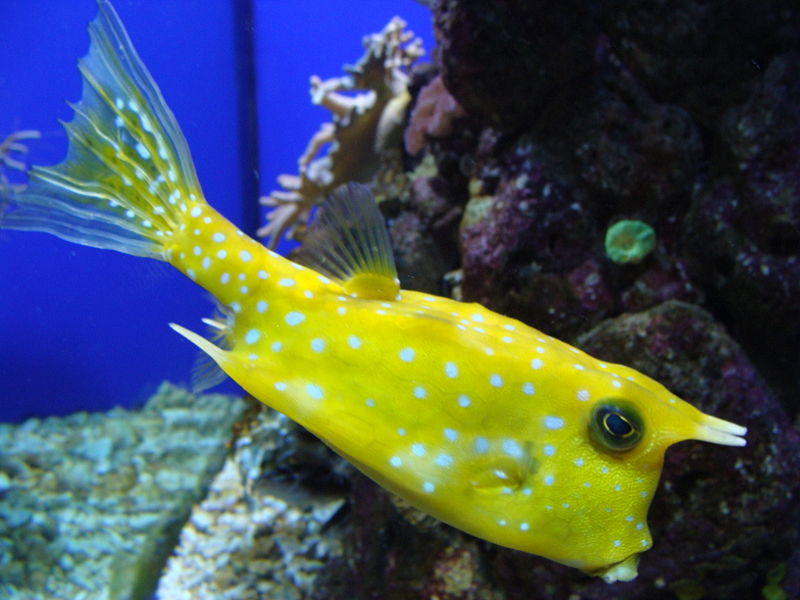
Longhorn Cowfish

Animal Unique | Longhorn Cowfish | Longhorn Cowfish, Lactoria cornuta, is a lot of Ostraciidae boxfish family, recognizable by its long horns that protrude from the front of the head, and as a cow or bull. They are located in the Indo-Pacific Ocean and can grow up to 20 cm in length. Although poorly suited to an aquarium at home, Cowfish is becoming increasingly popular as a pet.
Adults are reef fish, often solitary and territorial, living around the sand or debris on the bottom to a depth of 50 meters. They are omnivorous, feeding on benthic algae, and foraminifera of various microorganisms that strains from the sediments, sponges, polychaete worms from sand flats, molluscs, crustaceans and small fish, small, able to feed on benthic invertebrates by blowing a stream of water at the sandy bottom.
 
There is no known sexual dimorphism, so both men and women display yellow to olive base color, which is decorated with white spots or bluish. Paired courtship just before or after sunset. Eggs and larvae are pelagic.
 
One difference from the other fish is the lack of gill cover, which is replaced by a small gap or otwór.Sześciokątne plate as the fish scales are linked together in a solid, triangular, box-like carapace, from which the fins and tail protrude. Their unique way of swimming pool ostraciform called, makes it look as if they floated. They have no pelvic skeleton, so they lack pelvic fins. Are slow swimmers Cowfish easily caught by hand, grunting noise when captured. This is the most familiar species Cowfish aquarium trade.
 
If you are seriously stressed, this species may be able to secrete a deadly toxin, ostracitoxin and ichthyotoxic, hemolytic, heat-stable and not dialyzable, no toxic proteins in the mucous secretions of the skin. This is apparently unique among known fish poisons, are toxic to boxfish and resembles red tide and sea cucumber toxins in general properties.

Animal Discovery And Animal Unique In The World
Animal Unique

Rabu, 01 Juli 2015

American Goosefish


Animal Unique | American Goosefish | The American goosefish is described as largely a mouth with attached tail. A member of the family Lophiidae of deep-sea angler fish, the ugly, bottom-dwelling species of temperate waters is not a targeted gamefish, but occasionally caught by fishermen deep water below. More than two dozen species of angler fish exist worldwide, with American goosefish among them the biggest fish. American goosefish is also called Goosefish, American anglerfish, All-mouth or Fishing frog. It is native to the eastern coast of North America. It is found on sandy soils, gravel, shell fragments, mud and clay.sand soils, gravel, shell fragments, mud and clay.


Scientific classification
Kingdom:     Animalia
Phylum:     Chordata
Class:     Actinopterygii
Order:     Lophiiformes
Family:     Lophiidae
Genus:     Lophius
Species:     L. americanus

The American goosefish is dark brown, mottled with dark spots and blemishes. It has almost armlike pectoral is about halfway between its strongly flattened body. Small gill openings are behind them. The head is very large for its body size, and the mouth is cavernous, filled with sharp, curved teeth, and opening up. At the tip of the first spine is a flap of flesh that serves as a decoy to attract small fish within reach of the mouth graspingn. When the prey comes close enough, the American goosefish opens his big mouth and sucks his victim inside.


American goosefish have seen chocolate brown above, varied and finely mottled with pale and dark. The dorsal fins, the upper sides of the pectoral fins and tail are of a darker shade of same color as the back, except for nearly black at the ends, while the entire bottom of the fish is white or dirty white. Sometimes it is said, the top is dotted with white spots, but we have not seen any marked that way. Tiny described as mottled and speckled with green and brown.


The growth rate of American goosefish is fairly rapid and similar for both sexes until about four years, when about 19 cm long. After this, the women a little faster and seem to live longer, about 12 years, growing to just over 39 inches. Their maximum weight is 50 kilos, and the all-tackle world record is 49 pounds, 12 ounces. Sexual maturity occurs between the ages of 3 and 4. Spawning occurs from spring to early autumn, depending on latitude. Females lay a nonadhesive, mucoid floating egg raft or veil, which can be large as 39 meters long and 5 meters wide.


The American goosefish is an ambush predator. Most of his time on the sea floor partially covered with sediment waiting for suitable prey to pass. It can slow or "walk" swim with the help of his pectoral fins. The diet normally consists of fin and ray fish, squid, octopus and occasionally carrion. The meat of the monkfish is mainly located in the body, less in the "shoulders" and cheeks. The flesh is very white and moist, and was fairly firm when cooked. It is served in both soups and grilled, and is similar in texture to the meat of crustaceans. Boneless fillets are thick and like crab or lobster tail. Experts believe that the liver is also excellent. The fish is covered with a smooth, scaleless, elastic skin, where another thin membrane covering edible flesh.

Animal Discovery And Animal Unique In The World
Animal Unique

Atlantic Wolffish


Animal Unique | Atlantic Wolffish | Eel-like in body shape, the Atlantic wolffish are blenny family members to live in the cold Arctic waters of the Atlantic and Pacific. They are members of the family Anarhichadidae that includes seven species. The Atlantic wolffish also known as the Seawolf, Atlantic catfish, ocean catfish, eel wolf (the generic name of the Pacific relative), or sea cat, is a marine fish, the largest of the catfish family Anarhichadidae. Although it looks frightening, the Atlantic wolffish is only a threat to humans in defending itself from the water. The Atlantic wolffish inhabit both the west and east coasts of the Atlantic Ocean.


Scientific classification
Kingdom:     Animalia
Phylum:     Chordata
Class:     Actinopterygii
Order:     Perciformes
Family:     Anarhichadidae
Genus:     Anarhichas
Species:     A. lupus

Atlantic wolffish has long, subcylindrical in front, compressed in the caudal portion, smooth and slippery, the rudimentary scales embedded and almost hidden in the skin. Atlantic wolffish vary in color, usually seen as a purplish-brown, a dull olive green or bluish gray. The catfish lacks pelvic fins, and the dorsal fin, which begins just behind the head, extends to the caudal fin, but is not linked. The anal fin extends about half the length of the ventral surface. Atlantic wolffish have powerful jaws and a large number of wide-tooth used to the shells of mollusks and crustaceans crush. They also have sharp canines.


The Atlantic wolffish are primarily stationary fish, rarely moving from their rocky home. They are benthic dwellers, living on the ocean floor hard, often seen in corners and small caves. The sides of the gray-brown to purple body crossed by as many as a dozen vertical black bars. It is sedentary and rather lonely and is often found at depths of 45 to 65 fathoms. Populations are usually localized. Although the seems slow, it's bitter, it can quickly move short distances, and gives serious bites. Individuals can reach a length of 5 meters and weighs 40 pounds. They hunt for mollusks, crabs, lobsters and sea urchins. They do not eat other fish. 


The Atlantic wolffish is rarely caught by anglers and is usually taken by commercial otter. It has been overexploited and depleted in the western Atlantic Ocean. In the North Atlantic, similar sequences are spotted wolffish (A. minor) and the Northern wolffish (A. denticulatis). In the North Pacific, the very similar Bering wolffish (A. orientalis) comes from the Aleutian Islands in Alaska south to central California. The wolf-eel (Anarrichthys ocellatus) has a similar range, but reaches a length of 61 / 2 feet. These species are also caught by trawlers ommercial.


The way of the Atlantic wolffish fertilize their eggs distinguishes them from many fish. Instead of the female depositing her eggs in the open ocean and for males to fertilize and then continued on his way, they are internally fertilized and the male catfish remain in the nest and protects the eggs as long as four months, until the breeding is strong enough to gain independence. Their eggs are 5.5 to 6 mm in diameter (one of the largest known fish eggs), yellow-tinted and opaque. The eggs are laid on the ocean floor, many times in shallow water, stick together in loose groups, surrounded by rocks and seaweed. Atlantic wolffish mature relatively late, at the age of six.


In the north they are valued as food, both fresh and preserved. They are sold in Britain as "Scotch Halibut" and "Scarborough Woof" or simply "Woof" in other areas of the north-east coast, and are a popular ingredient in fish and chips. The oil extracted from the liver is said to be equal in quality to the best liver. According to scientific data, the Atlantic wolffish populations drastically declined due to overfishing and bycatch. Bottom trawling vessels also disrupt the Atlantic wolffish the rocky underwater habitat when dragging large nets along the seabed, with heavy weights to the nets on the ocean floor. The nets are randomly what they catch and the heavy weights and nets are harmful to the benthic terrain and its inhabitants. The sport has also threatened the survival of the Atlantic wolffish.

Animal Discovery And Animal Unique In The World
Animal Unique